GTA 5: The 2011 Debut Trailer vs. the Final Game
Rockstar's first GTA V trailer landed in November 2011, almost two years before the game shipped. Here is exactly what changed between that first look and the Los Santos players actually got in 2013.
Rockstar Games released the first trailer for Grand Theft Auto V on November 2, 2011, nearly two full years before the game reached shelves on September 17, 2013. In under a minute and a half, narrated by Michael De Santa over "Ogdens' Nut Gone Flake" by Small Faces, it set off one of the most obsessive frame-by-frame analysis campaigns the series had ever seen. Fans built theories about mechanics that never shipped, mapped out Los Santos from scraps of footage months before release, and argued over background details that turned out to mean nothing at all.
With GTA 6 now going through the exact same cycle of trailer breakdowns and community theories, it is worth revisiting what Rockstar's first GTA V trailer actually promised, and how much of it survived contact with the final, shipped game.
The essentials
- Released November 2, 2011, about 22 months before launch
- Narrated by Michael De Santa, scored to "Ogdens' Nut Gone Flake" by Small Faces
- A fast-cut montage of Los Santos life: crime, leisure activities and a handful of landmarks
- Sparked a fan theory about a full real estate system that never shipped in story mode
- Denser foliage, brighter lighting and unique pedestrian animations were toned down or cut for the original release
- Some cut props were quietly restored in the 2014-2015 PS4, Xbox One and PC re-release
A trailer built to be picked apart
The 2011 trailer was deliberately vague. It showed no HUD, no mission names and almost no dialogue beyond Michael's narration, which is exactly why the community treated every frame as a clue. Rockstar had gone nearly five years since GTA IV, the longest gap between mainline entries at that point, and fans used the footage to build a fan-made map of Los Santos that turned out to be remarkably close to the real thing once the game shipped in 2013. That same obsessive mapping habit is happening again right now with GTA 6, just with more raw footage to work from and a much larger, much faster online community doing the digging.
None of this is unique to Rockstar. Every studio cuts a debut trailer to sell a fantasy first and a shippable product second. What makes the GTA V case useful three years on from GTA 6's own reveal is how well-documented the gap turned out to be: modders, data miners and side-by-side video essays spent years cataloguing exactly what changed, which makes it one of the clearest case studies the series has for how much a first look can drift from the final release.
The real estate tease that never paid off
A few seconds into the trailer, a "sold" sign appears on the lawn of a suburban house. Fans took it as proof that GTA V's story mode would let Michael, Franklin and Trevor buy and flip real estate, something the series had never fully delivered. The base game shipped without any such system. GTA Online eventually let players buy apartments and businesses, but that arrived after launch as a multiplayer feature and works nothing like the property-flipping fantasy the trailer implied. Data miners later confirmed the prop is still sitting unused in the final game's files: the tramp character who appears to hold the sign never actually holds it in the shipped animation.
Another popular theory claimed a homeless man glimpsed around the 58-second mark was a washed-up Niko Bellic making a cameo from GTA IV. It made for a fun bit of speculation at the time, but nothing in the final game ever confirmed it.
A denser, brighter world
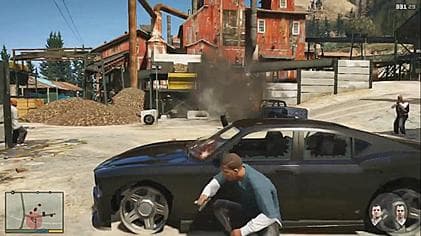
Side-by-side comparisons between the trailer and the shipped game show a noticeably greener, more overgrown Los Santos in the marketing footage. Vegetation density along several roads and hillsides is visibly higher in the trailer than what PS3 and Xbox 360 hardware could actually render at launch, a limitation the last-generation consoles simply could not push past without tanking the frame rate. Lighting and color grading are also more saturated in the trailer, with a brighter sun and richer skies than the in-game engine produced on release. It is a common trick for pre-release marketing: build the shot for maximum visual impact rather than for what the shipping hardware can sustain in open, playable space.
Animations and props that stayed in the trailer
Several pedestrian animations shown in the trailer, including specific walk cycles and interactions, were captured specifically for the marketing footage and do not appear in general gameplay. Some props visible in the background were also stripped from the original PlayStation 3 and Xbox 360 release, likely for the same performance reasons that thinned out the foliage. It is a reminder that a debut trailer is a proof of concept and a sales pitch first, built on the engine's ceiling rather than its everyday performance budget.
What came back in the next-gen version
Not everything cut from the 2013 release stayed gone. When Rockstar reissued GTA V for PlayStation 4, Xbox One and PC in late 2014 and early 2015, extra rendering headroom let some of those trimmed props and denser environmental details make a return, closing part of the gap between the original trailer's ambition and what players could actually walk through. It is one of the clearer examples in the series of a "next-gen" re-release actually catching up to a pre-release trailer rather than the other way around.
The rest of the campaign, for context
The debut trailer was only the opening move. Rockstar followed it with a second trailer in November 2012, then split the marketing into three separate character trailers for Michael, Franklin and Trevor in the spring of 2013, each cut to a different song and tone to match the character. A dedicated gameplay video arrived that summer, only weeks before launch, and finally showed systems the 2011 teaser had only hinted at: the three-protagonist switching mechanic, heist planning, and the open-world traffic and pedestrian density players would actually get to touch. Compared to that later footage, the original debut trailer looks almost like a mood board: heavy on atmosphere, light on confirmed mechanics.
Nearly two years of near-silence
The gap between that first trailer and launch day, close to 22 months, was unusually long for the series at the time and set a pattern Rockstar has leaned on ever since: tease early, then let the internet do the marketing through months of analysis and speculation. Anyone who lived through GTA V's 2013 launch window and the record-breaking sales that followed will recognize the shape of the campaign, because GTA 6's own marketing has followed the same slow-burn rhythm on a much bigger scale.
Why it matters going into GTA 6
The lesson from 2011 is simple: debut trailers are aspirational documents, not literal previews. Denser foliage, brighter lighting, unused animations and a real estate feature that quietly disappeared are all small examples of a much bigger pattern seen in nearly every big-budget game reveal. As the community keeps combing through every new GTA 6 trailer for hidden details, the GTA V precedent is a useful gut check: some of what looks confirmed on screen today may still change, get trimmed, or simply never make the cut by the time Leonida ships. If you want the full list of what is currently confirmed rather than speculated, the GTA V 100% completion checklist and a broader look back at how GTA Online played in 2013 are good places to see what actually shipped versus what fans expected.
Comments (0)
No comments yet. Be the first!